

Operator
Repeat as necessary, 2026
Repeat as necessary is a 31-minute performance and an activation of the technology of the body itself. Movement, sound, and costume form a hybrid ritual system. The body's hidden protocols activated: mirror neuron networks, autonomic regulation, collective neural entrainment. It was designed from the start to be both experience and infrastructure. Every parameter needed to regenerate the work (notation, music, frequencies, costumes, choreographic direction) lives permanently on-chain. Not as documentation of a past event, but as a functional system that can generate the experience again. Operator calls this a Performance Operating System. Repeat as necessary is the first artwork built this way. Documentation captures what happened, not what can happen.Preserving an object means preventing change. Preserving a performance means the opposite: handing over the parameters that created it and allowing it to live again. Every model depends on a system outside the work itself. Every previous model separates the work from the system that keeps it alive. Operator's Performance Operating System collapses them into one. Not instructions added after. Not reconstruction from fragments. Not oral tradition dependent on memory. Not knowledge held by specific people. The system is the work. Not documentation of a past performance, but the engine for future ones.
What the Performance Operating System changes:
FOR PERFORMANCE ART: A permanent system, on-chain and transparent, that can generate performances indefinitely. No foundation. No gatekeeper. No dependency on any living person.
FOR ARTISTS: A performance that can transact like visual art. Sell a generative system while retaining practice.
FOR INSTITUTIONS + ESTATES: A protocol. Open architecture. Any artist or institution can adopt the Performance Operating System for their own work.
FOR COLLECTORS: The complete system to restage a live performance. Not relic of a past event, but the engine for future ones. Anyone can read the system on-chain. One collector owns it.
CORE INNOVATIONS:
EXPLICIT: Every parameter of the performance made explicit before it was ever staged. Not reconstructed after. Not salvaged from memory. 40 formations with exact timing. Hz frequencies for each chapter. Costume specifications mapped to the body. Choreographic direction in the artist's voice. The intended effect on the viewer's nervous system. Nothing left inside anyone's head.
MACHINE READABLE: Every parameter structured as on-chain data, queryable by contract. Not prose requiring interpretation. Not video requiring expertise. Not oral tradition requiring access to the right people. Embodied knowledge, made legible to machines.
TRUSTLESS: The work does not depend on any living person, any single institution, or any ongoing funding to remain complete and accessible. No foundation. No archive. No gatekeeper. The performance outlives everyone who made it.
The explicitness enables the machine-readability.
The machine-readability enables the trustlessness.
What required governments, foundations, and decades of archival labor for previous generations of performance artists exists here by design, from the start.
WHAT WAS BUILT:
THE PERFORMANCE OPERATING SYSTEM (1/1): A single collector holds the complete architecture for restaging the performance. Music, costumes, choreographic direction, video reference, notation legend, provenance. All stored permanently on Ethereum. This is the engine.
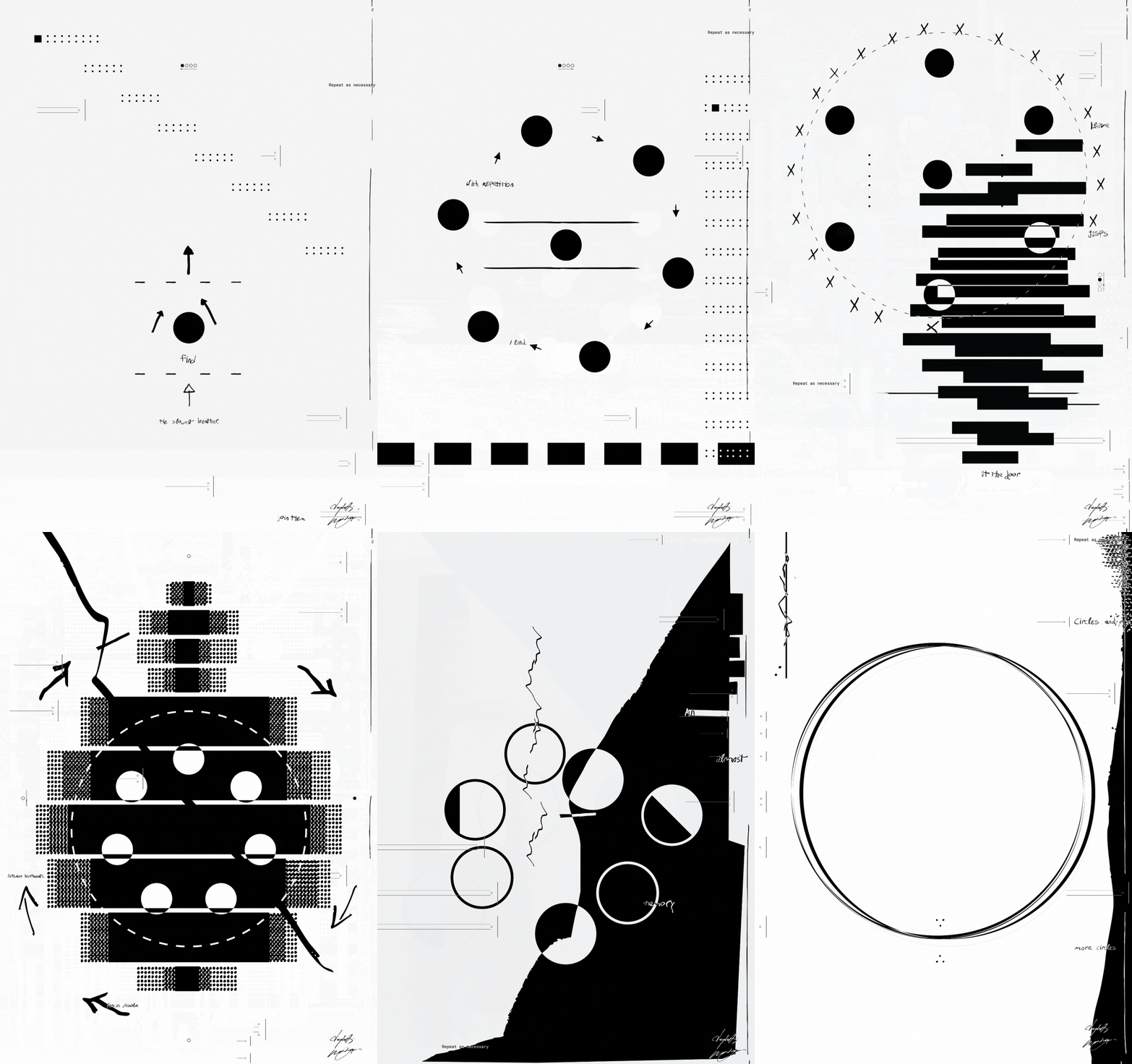
THE 40 NOTATIONS: The 31-minute performance is encoded into 40 formations, each representing a segment of the work as its own on-chain artwork, fully rendered as SVG from contract data. A custom notation system encoding dancer movement, breathing patterns, sound frequencies, and intended states inside the viewer's body. The Performance Operating System reads from them, connecting the collection into a living system.
PERFORMANCE OPERATING SYSTEM (1/1):
AN ARTWORK THAT DISPLAYS ITS OWN INFRASTRUCTURE: One collector holds the complete architecture for restaging Repeat as Necessary. The registry smart contract acts as a living interface (dynamic NFT) and maintains the structure and locations of every component in the system and defines roles for a steward or archivist who can continue adding to the contracts, updating data, and extending the system over time.
Nine smart contracts on Ethereum. Everything needed to restage the performance exists permanently on-chain. Full backup on Arweave (200-year minimum guaranteed storage).
1. registry contract (index and dynamic NFT interface of all operating system on-chain components)
2. notation legend to decode individual scores,
3. motion data of signature moves,
4. music score and its frequencies,
5. costume specifications mapped to body zones,
6. choreographic direction in the artist's voice,
7. video timemap linking every notation to the premiere,
8. provenance ledger that grows with each restaging,
9. collection of 40 notations
Not documentation of a past performance, but the engine for future ones.
PERFORMANCE OPERATING SYSTEM (1/1):
A LIVING INTERFACE CONTAINING ALL COMPONENTS TO GENERATE AN ENTIRE PERFORMANCE: Rooted in the afterimage: stare at something intensely, look away, fatigued photoreceptors produce a complementary ghost. The cyan spectrum reflects this physiology.
THREE ZONES:
Registry Contract Visualised: Reads live on-chain data from its own contracts. Every contract indexed, every connection maintained, the full operating system rendered as navigable interface. The registry maintains the structure and locations of all components, defines roles for ongoing stewardship.
Afterimage: Hand-drawn burn map, charcoal on black paper, stored as base64. Longer formations burn brighter.
Entrainment Field: Tracks holdings across the 40 Notations. When a wallet holds one token from each chapter, entrainment is achieved: cyan intensifies, wallet address appears.
40 NOTATIONS & TECHNICAL DEPTH:
FULL ON-CHAIN RENDERED NOTATION: Each notation is a visual artwork and a choreographic score in one. A custom visual language built from structural compositions translated into charcoal drawings, then vectorised into on-chain SVG libraries. Four visual chapters trace the performance's nervous system journey: threshold, entrainment, dissolution, garden. Dots for seven dancers, arrows for movement flow, chapter-specific breathing symbols, aphoristic statements. Experimental music notation meets concrete poetry. Every mark is a parameter. Timing, Hz frequencies, fabric placement, breath patterns, intended states inside the viewer's body. What is notated is not just what the performers do, but what happens inside the audience.
Fully on-chain. Not references to external files. Vector graphics generated from compressed data stored across ~100 smart contracts on Ethereum.
40 NOTATIONS & TECHNICAL DEPTH:
ON-CHAIN RENDERING PIPELINE: When a notation is requested, the smart contract assembles it in real time. Global symbol libraries, chapter-specific styles, and token-specific layout data are each read from separate SSTORE2 storage contracts, decompressed via LibZip, and composed into a complete SVG. No external server. No API. No IPFS. The artwork is generated from Ethereum itself, every time it is viewed.
1. 100 storage contracts deployed
2. 97% gas reduction via SSTORE2
3. 63% symbol deduplication (1,655 to 620 unique)
4. 34.5% compression via LibZip
Arweave fallback if RPC limits exceeded
THE NOTATION LEGEND: 60 pages. Four chapters. One reading system.
The Notation Legend is the key to the collection—a 60-page document mapping every visual element across all four chapters. It exists as a companion to the 40 on-chain scores and as a standalone work. Every symbol transforms across the performance arc. Breathlines shift from irregular dashes to synchronised waves to explosive rupture to gentle curves. Dancer dots dissolve from solid to outline as individual boundaries soften. In Chapter 3, the navigation markers themselves dissolve: the system enacting what it describes. What is notated is not only what performers do. It is what happens inside everyone present.
PERFORMANCE DESCRIPTION: Repeat as necessary is an experience as well as an activation of the technology of the body itself.
Choreography becomes an instruction manual for forgotten circuitry, ancient patterns inscribed in the flesh. Rather than considering technology as something outside ourselves, this work recognises the body as a formidable instance of technology. Through repetitive movement something begins to dissolve: the boundaries between here and elsewhere, self and other, audience and performer, boredom and revelation. The rhythmic architectures of sacred chant and Sufi sema music, rooted in neural entrainment through repetition, breath, and modal tension, are reimagined not as doctrine, but as sonic architectures for nervous system attunement. Woven together, movement, sound, costume design form a hybrid ritual system: pulse and posture, fabric and form, guiding the body toward trance not through belief, but through sensation. What emerges beyond the terror of staying still is an archaeology of presence. The body's hidden protocols activated: mirror neuron networks, autonomic regulation, collective neural entrainment.
In other words: become worse at being elsewhere.
What the Performance Operating System changes:
FOR PERFORMANCE ART: A permanent system, on-chain and transparent, that can generate performances indefinitely. No foundation. No gatekeeper. No dependency on any living person.
FOR ARTISTS: A performance that can transact like visual art. Sell a generative system while retaining practice.
FOR INSTITUTIONS + ESTATES: A protocol. Open architecture. Any artist or institution can adopt the Performance Operating System for their own work.
FOR COLLECTORS: The complete system to restage a live performance. Not relic of a past event, but the engine for future ones. Anyone can read the system on-chain. One collector owns it.
CORE INNOVATIONS:
EXPLICIT: Every parameter of the performance made explicit before it was ever staged. Not reconstructed after. Not salvaged from memory. 40 formations with exact timing. Hz frequencies for each chapter. Costume specifications mapped to the body. Choreographic direction in the artist's voice. The intended effect on the viewer's nervous system. Nothing left inside anyone's head.
MACHINE READABLE: Every parameter structured as on-chain data, queryable by contract. Not prose requiring interpretation. Not video requiring expertise. Not oral tradition requiring access to the right people. Embodied knowledge, made legible to machines.
TRUSTLESS: The work does not depend on any living person, any single institution, or any ongoing funding to remain complete and accessible. No foundation. No archive. No gatekeeper. The performance outlives everyone who made it.
The explicitness enables the machine-readability.
The machine-readability enables the trustlessness.
What required governments, foundations, and decades of archival labor for previous generations of performance artists exists here by design, from the start.
WHAT WAS BUILT:
THE PERFORMANCE OPERATING SYSTEM (1/1): A single collector holds the complete architecture for restaging the performance. Music, costumes, choreographic direction, video reference, notation legend, provenance. All stored permanently on Ethereum. This is the engine.
THE 40 NOTATIONS: The 31-minute performance is encoded into 40 formations, each representing a segment of the work as its own on-chain artwork, fully rendered as SVG from contract data. A custom notation system encoding dancer movement, breathing patterns, sound frequencies, and intended states inside the viewer's body. The Performance Operating System reads from them, connecting the collection into a living system.
PERFORMANCE OPERATING SYSTEM (1/1):
AN ARTWORK THAT DISPLAYS ITS OWN INFRASTRUCTURE: One collector holds the complete architecture for restaging Repeat as Necessary. The registry smart contract acts as a living interface (dynamic NFT) and maintains the structure and locations of every component in the system and defines roles for a steward or archivist who can continue adding to the contracts, updating data, and extending the system over time.
Nine smart contracts on Ethereum. Everything needed to restage the performance exists permanently on-chain. Full backup on Arweave (200-year minimum guaranteed storage).
1. registry contract (index and dynamic NFT interface of all operating system on-chain components)
2. notation legend to decode individual scores,
3. motion data of signature moves,
4. music score and its frequencies,
5. costume specifications mapped to body zones,
6. choreographic direction in the artist's voice,
7. video timemap linking every notation to the premiere,
8. provenance ledger that grows with each restaging,
9. collection of 40 notations
Not documentation of a past performance, but the engine for future ones.
PERFORMANCE OPERATING SYSTEM (1/1):
A LIVING INTERFACE CONTAINING ALL COMPONENTS TO GENERATE AN ENTIRE PERFORMANCE: Rooted in the afterimage: stare at something intensely, look away, fatigued photoreceptors produce a complementary ghost. The cyan spectrum reflects this physiology.
THREE ZONES:
Registry Contract Visualised: Reads live on-chain data from its own contracts. Every contract indexed, every connection maintained, the full operating system rendered as navigable interface. The registry maintains the structure and locations of all components, defines roles for ongoing stewardship.
Afterimage: Hand-drawn burn map, charcoal on black paper, stored as base64. Longer formations burn brighter.
Entrainment Field: Tracks holdings across the 40 Notations. When a wallet holds one token from each chapter, entrainment is achieved: cyan intensifies, wallet address appears.
40 NOTATIONS & TECHNICAL DEPTH:
FULL ON-CHAIN RENDERED NOTATION: Each notation is a visual artwork and a choreographic score in one. A custom visual language built from structural compositions translated into charcoal drawings, then vectorised into on-chain SVG libraries. Four visual chapters trace the performance's nervous system journey: threshold, entrainment, dissolution, garden. Dots for seven dancers, arrows for movement flow, chapter-specific breathing symbols, aphoristic statements. Experimental music notation meets concrete poetry. Every mark is a parameter. Timing, Hz frequencies, fabric placement, breath patterns, intended states inside the viewer's body. What is notated is not just what the performers do, but what happens inside the audience.
Fully on-chain. Not references to external files. Vector graphics generated from compressed data stored across ~100 smart contracts on Ethereum.
40 NOTATIONS & TECHNICAL DEPTH:
ON-CHAIN RENDERING PIPELINE: When a notation is requested, the smart contract assembles it in real time. Global symbol libraries, chapter-specific styles, and token-specific layout data are each read from separate SSTORE2 storage contracts, decompressed via LibZip, and composed into a complete SVG. No external server. No API. No IPFS. The artwork is generated from Ethereum itself, every time it is viewed.
1. 100 storage contracts deployed
2. 97% gas reduction via SSTORE2
3. 63% symbol deduplication (1,655 to 620 unique)
4. 34.5% compression via LibZip
Arweave fallback if RPC limits exceeded
THE NOTATION LEGEND: 60 pages. Four chapters. One reading system.
The Notation Legend is the key to the collection—a 60-page document mapping every visual element across all four chapters. It exists as a companion to the 40 on-chain scores and as a standalone work. Every symbol transforms across the performance arc. Breathlines shift from irregular dashes to synchronised waves to explosive rupture to gentle curves. Dancer dots dissolve from solid to outline as individual boundaries soften. In Chapter 3, the navigation markers themselves dissolve: the system enacting what it describes. What is notated is not only what performers do. It is what happens inside everyone present.
PERFORMANCE DESCRIPTION: Repeat as necessary is an experience as well as an activation of the technology of the body itself.
Choreography becomes an instruction manual for forgotten circuitry, ancient patterns inscribed in the flesh. Rather than considering technology as something outside ourselves, this work recognises the body as a formidable instance of technology. Through repetitive movement something begins to dissolve: the boundaries between here and elsewhere, self and other, audience and performer, boredom and revelation. The rhythmic architectures of sacred chant and Sufi sema music, rooted in neural entrainment through repetition, breath, and modal tension, are reimagined not as doctrine, but as sonic architectures for nervous system attunement. Woven together, movement, sound, costume design form a hybrid ritual system: pulse and posture, fabric and form, guiding the body toward trance not through belief, but through sensation. What emerges beyond the terror of staying still is an archaeology of presence. The body's hidden protocols activated: mirror neuron networks, autonomic regulation, collective neural entrainment.
In other words: become worse at being elsewhere.
Further images


1
of
2