-
Still Image
-
-

Sarah Meyohas
Sarah Meyohas (b. 1991, New York) is a conceptual artist and technologist whose practice provides an intelligible visual language to articulate the complex operations that govern our world. Notable projects include Bitchcoin (2015), Infinite Petals (2025), and the Interferences (2021–).
Her filmography includes CLOUD OF PETALS (2017) and MEDUSA (2024). She was also an executive producer for THE BRUTALIST (2024). Her work has been collected and exhibited at major institutions such as the Centre Pompidou in Paris, the ICA in London, and the New Museum in New York. She is represented by Marianne Boesky Gallery as well as the United Talent Agency for her work in film.
Meyohas currently invests through Bluebirds Capital and is a founding advisor to Sita.Bio. She is a co-founder of the event space, 102 Franklin, and co-owner of the bar, Honey’s. -
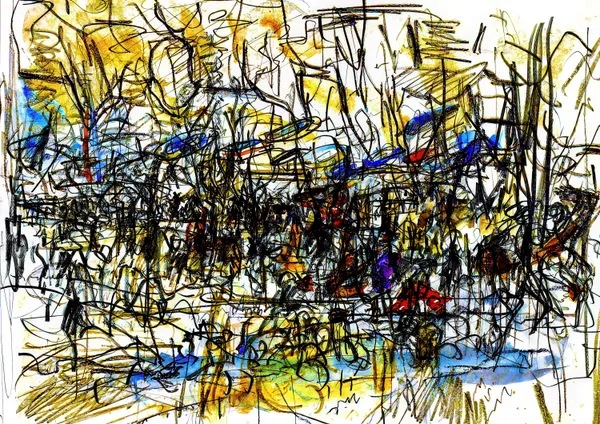
'Untitled', 2025
Pastel on paper132.1 x 96.5 cmOver the past two years, Meyohas has been developing a pastel plotter—an inherently contradictory combination of messy, nostalgic pastels and the machine precision of plotters. This setup allows for the creation of pastel drawings with up to 1 million vectors and an equal distribution of up to 130 colors, achieving a degree of visual complexity never before achieved with this tool in its roughly 70-year existence, and ensuring that each hue’s tonality is mathematically balanced. Her primary interest in working with plotters is their historical reliance on “low entropy” mediums, such as pens, which align with the precise nature of a drawing machine (as seen in commercial pen plotters like AxiDraw). These implements don’t require blending, making them perfect for straightforward, predictable mark-making. In contrast, pastels and paints are “high entropy” mediums, demanding intricate blending, nuanced mark-making, and transparency. They are inherently unpredictable, reacting dynamically with other media and the drawing surface. Meyohas has been developing a machine capable of managing this unpredictability. In this case, thus far the key elements are pastels—among the oldest, most classical drawing implements in art history—and computer plotters—machines only invented as recently as the 1950s to automate the act of drawing. Beyond their obvious differences in age, the two tools also diverge on other levels. Pastels are associated with messiness, sentimentality, and nostalgia; plotters are associated with precision, emotionlessness, and modernity. One conjures mental images of the Old Masters or the Impressionists capturing nature at its most transcendent; the other conjures mental images of bespectacled men in lab coats debugging code. The complexity of the process and the resulting images lead to a particular phenomenological experience for the viewer. Up close, each drawing looks like nothing more than a squall of colorful visual noise. But back up, and the noise resolves into a nearly photo-quality representational image. No human would be able to execute a pastel drawing in this way, no matter how skilled or obsessive they might be, just as no machine (yet) would be able to generate an underlying composition with the humanity or care of a human-captured photograph.
52 x 38 in
-
-
-
William Mapan
Based in Paris, William Mapan (b.1988) is a pioneer in the digital art space. With a background in software development, he combines computer science with his passion for pigment, light and texture. One of Mapan’s most notable works is his Dragons series (2021), in which he shared a portion of the works’ ownership with his collectors during the process of creation. He often combines contrasting ideas which juxtapose one another. In Dragons, he highlighted the symbolism of the mythical beast that represents wisdom in China, but is often associated with destruction and decay in Western culture.
Frequently alternating between different mediums, Mapan relies on creativity, chance and the exact shades of lightness within each of the works. In the Anticyclone series, he capitalised on the contrasts between dark and light to produce works focused on the erratic patterns of weather phenomena. Notably, Mapan codes, creates, and teaches at Gobelins, l’école de l’image in Paris.
-
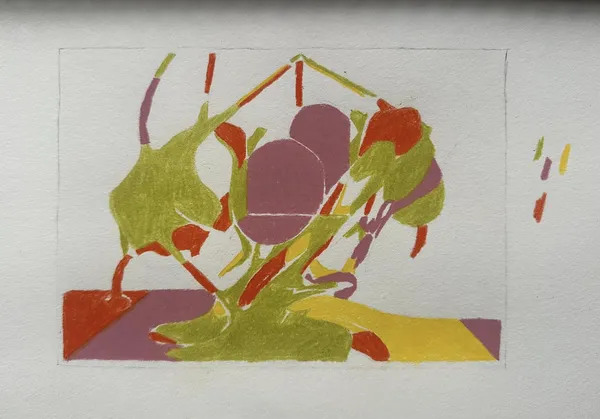
'Untitled', 2026
Crayon on paper15 x 21 cm
5 7/8 x 8 1/4 inGenerative surrealism: organic forms collide with geometric frames across ambiguous grounds. Biomorphic masses drift through impossible interiors, up against tangled architectures. The volumes spill as if gravity is negotiating its own rules. The algorithm generates landscapes, surreal theatres where sculpture becomes scenery, and every output opens onto a different room. Each one carries weight, tension, and spatial contradiction. A unique world, always on the verge of coming apart.
-
-
-
-
Emi Kusano
Emi Kusano is a multidisciplinary artist whose practice integrates emerging technologies, including AI, to explore nostalgia, pop culture, and collective memory. By visualizing the dialogue between past and present through a retro-futuristic aesthetic, she invites viewers to reconsider contemporary society.
Her work has been internationally exhibited in over 20 countries at major institutions including M+ (Hong Kong), Saatchi Gallery (London), Grand Palais Immersif (Paris), and the 21st Century Museum of Contemporary Art, Kanazawa, as well as at major international art fairs such as Frieze and Paris Photo. Her artistic roots lie in street photography, and her early archival work on Harajuku fashion was featured at the Victoria and Albert Museum (London).
Kusano has realized a commissioned project associated with the seminal cyberpunk work Ghost in the Shell, and participated in collaborative auctions with Christie's for Gucci and UNHCR. She was recognized by the World Economic Forum as a Young Global Leader in 2025 and a Cultural Leader in 2026.
Having served as a lecturer at Tokyo University of the Arts, she currently serves on Japan's Agency for Cultural Affairs' Copyright Subcommittee, addressing issues of authorship and rights in the algorithmic age. Her background also includes leading the synth-wave unit Satellite Young.
-
'Ornament Survival: Echo Chamber of Care', 2026
AI Photography, Print on Paper, Aluminium frame84.1 x 59.4 cm
33 1/8 x 23 3/8 inSet against the backdrop of an attention economy flooded with AI-generated content, "Ornament Survival" is a photographic series exploring the polysemy of the word "model." The countless figures crowding these images, clad in standardised uniforms, offer attentive care. They embody the societal "role models" historically expected of women, while simultaneously acting as the literal "AI models" (model data) driving the system.
Kusano built a custom AI model trained on her own face and body to direct these generated clones in performing endless acts of emotional labor. This process embodies a contemporary reality: one where cuteness and attentiveness are stripped of identity, becoming mass-producible specifications.
In Japanese subculture, "transformation" has long been an ambivalent act—simultaneously a symbol of empowerment and an object of sexual consumption. In this work, that act is coldly updated as a harsh survival strategy: optimising oneself into an "ornament" simply to survive the system's metrics. Through overwhelming multiplicity, Kusano visualises the distortion of a society that consumes humans as vessels for data.
-
-
-
ThankYouX
ThankYouX, a painter from Los Angeles, California, began his artistic career in 2009. Starting as an acclaimed yet anonymous street artist, over the last fifteen years, his work has evolved into experimentation with geometric forms and layered abstraction that is now internationally recognized.
As an enthusiastic proponent of emerging technology, ThankYouX expanded his artistic practice in 2020, when he started exploring and creating digital blockchain-based artwork. He quickly became one of the leaders in the space, bridging the gap between traditional art and Web 3.0.
Notable moments include his solo show ‘Inertia’ at Sotheby’s gallery in LA, a collaboration with Hans Zimmer, inclusion of his work in institutions like the The Museum of the Future in Dubai and The Bechtler Museum of Modern Art, partnerships with major auction houses as both an artist and curator, and his groundbreaking solo project, “State Of The Art” which blends digital and physical art in ways that push both mediums forward.
-
'Take Me By The Hand', 2025
Acrylic, oil pastel and enamel on canvas168 x 147 cmThe artwork begins as a physical painting and then extends into a digital animation, using technology to push what a painting can be. All assets are included in the folder, and at the event you can display the digital component that accompanies the physical work. Ultimately, the piece explores what a “still image” can mean in today’s modern world.
66 1/8 x 57 7/8 in"Harmony >< Tension is a series of paintings paired with digital works exploring the balance between opposing forces: order and chaos, peace and pressure, the physical and the virtual. Rooted in both technology and traditional painting, ThankYouX approaches each work through a dual lens, screen and brush, iteration and intuition. Each piece exists as a dialogue between canvas and digital form, extending the still image into motion while retaining the gesture and materiality of paint. Colour becomes emotional architecture rather than a fixed palette. Oceanic blues evoke calm and depth; maroon carries density and resilience. Warm undertones bridge these extremes, grounding abstraction in something human.Rather than resolving opposition, Harmony >< Tension embraces coexistence, holding softness and structure, vulnerability and control in balance."
-
-
-
Philipp Frank
Philipp Frank, a visionary land-light artist, and photographer from Germany, merges nature, technology, and emotion to craft immersive spaces and captivating imagery that defy conventional boundaries. His innovative creations challenge viewers to rethink their perceptions of space and time, drawing inspiration from natural phenomena, science, and philosophy. With a background in graffiti art and a Master's degree in Communication Design, Frank's journey has evolved into a deep exploration of the interconnectedness of nature and the human experience. Through his evocative works, he invites audiences on a transformative journey of introspection and discovery, infusing each piece with a profound sense of soulful expression inspired by Kahlil Gibran's belief that "Work is love made visible."
-
'Mykonos Lightcodes #11', 2025
Projection Mapping at Scorpios Mykonos
Unique signed fine art print accompanied by matching digital companion (NFT).50 x 70 cm
19 3/4 x 27 1/2 in"Mykonos Light Codes extends my ongoing artistic practice of working with natural stone as a resonant surface. I was invited to develop a site-specific light work for Scorpios in Mykonos — a landscape defined by strong geological formations and an intense social atmosphere. My broader concept, explored in the series Stone Portals, centers on revealing latent structures within natural matter. I approach rock not as a backdrop, but as a carrier of time, tension and embedded memory. Through projection mapping, I activate these surfaces using five-minute moving light sequences that follow their physical logic — cracks, layers, textures and irregularities. In Mykonos, the task was to translate this language into a new context. The environment differed from the remote landscapes I often work in: wind, music and constant activity shaped the conditions. I moved through the site searching for freestanding, sculptural rock forms and surfaces that could hold the work visually and conceptually. Each intervention was created directly on location at dusk and existed only temporarily. From many recorded sequences and variations, 21 works were distilled into a deliberate one-of-one print edition. Each image is extracted from a live projection sequence and captures a singular, unrepeatable moment within that time-based process. The edition marks my first translation of ephemeral light interventions into a fixed, collectible form. At the core of the project lies a consistent idea within my practice: light reveals what time transforms. Mykonos Light Codes applies this principle to a new terrain, preserving brief perceptual shifts as physical traces." - Philipp Frank
-
-
-
Fahad Karim
Fahad Karim (b. 1990) is a South Asian new media artist who has lived a nomad’s life across the globe, moving between Switzerland, India, Bangladesh, Egypt, the Philippines, Mexico, and the US.
Using technology as his medium, Fahad builds systems to explore and examine human culture in a dynamic, modern context. His work often reimagines the traditional through automation, ranging across themes such as architecture, folklore, our relationship with technology, and the passage of time. Fahad employs a continuously evolving set of tools in his practice, including self-developed code-based systems, generative A.I., machine plotters, and blockchains.
Fahad received his formal education in computer science at Cornell University. His work has been collected and exhibited internationally, including at Sotheby's, Christie’s London, Zona Maco (CDMX), Art Blocks Curated (Season 8), and Bright Moments Gallery (CDMX & Venice). He was shortlisted for the Lumen Prize 2023 for his Aztec-inspired project Pohualli.
-
'Alan Ki Aankhen 0092', 2022
Alan Ki Aankhen is an exploration of other-worldly cityscapes in the visual aesthetic of my distinct style with ink on paper. The title, translated as Alan’s Eyes, alludes to Alan Turing’s machine intelligence test - a thought experiment foreshadowing a moment in which we can no longer differentiate between the real and the artificial. Though first proposed in 1950, the topic feels especially relevant today, as even our creative practices are being carried by shifting technological tides.
The algorithms and decision-making encoded into this generative art project intentionally imitate my approach on traditional mediums - composition rules, textures, and overall themes. The visual elements are inspired by memories from my nomadic life. You’ll find intricate windows from Rajasthan, massive Egyptian pyramids rising from the horizon, a density of civilisation only seen in New York, and the moon - a comforting and shared sight no matter where you stand.
-
-
-
Justin Aversano
Justin Aversano stands as a beacon in modern art, known for his profound storytelling through the lens. His groundbreaking series, "Twin Flames," has captivated audiences by not only showcasing the unique bond between twins but also weaving a tapestry of human stories that resonate universally. Through this work, Aversano delves into the complexities of identity, kinship, and the shared human experience.
Aversano’s artistic journey transcends traditional photography; he's a pioneer in the digital art revolution. By embracing blockchain technology, he has transformed how art is perceived and owned, introducing his creations as NFTs (Non-Fungible Tokens). This innovation has not only expanded his reach but has also redefined the dynamics between artist and collector, making art ownership more accessible and interactive.
His commitment extends beyond his personal creations. Aversano is a catalyst for community and dialogue within the art world. He actively participates in collaborative projects, exhibitions, and workshops, fostering an environment where art becomes a medium for connection and cultural exchange. His influence is seen in his efforts to blend technology with traditional art forms, challenging and inspiring how we envision the future of art.
Aversano’s work is a narrative tapestry, exploring themes of love, loss, and the intricate layers of human relationships. His art prompts reflection, encourages discussion, and invites viewers into a dialogue about what it means to be connected in an increasingly digital world. Through his lens, he captures not just images but moments in time that speak to the heart of the human experience.
As an artist, curator, and advocate, Justin Aversano's legacy is one of innovation, empathy, and a relentless pursuit to push the boundaries of art, making him a pivotal figure in both the analog and digital art landscapes.
-
'Moments of the Unknown 115 - July 31st', 2025
Moments of the Unknown is a 10-second Super-8 portrait series every day for a year on all 7 continentsSuper-8 filmAspect Ratio: 4:3
Resolution: 2880 x 2160
File Type: H.264 Codec / MP4Moments of the Unknown is a cinematic portrait of humanity. Over 366 days, I traveled across seven seas and seven continents to create ten-second portraits of people from all over the world, seeking to convey human oneness and celebrate diverse cultures through the moving image and the passage of time.
This humanist approach aims to foster acceptance and understanding through discovery, seeking wisdom for healing. It serves as a contribution toward world peace and an exploration of training artificial intelligence in empathy through artistic imagery. Exploring Super-8 analog film, artificial intelligence, and blockchain technology, the project captures memories as moments and moments as art.
Inspired by Edward Steichen's "Family of Man" exhibition (1955) and the "NASA Gold Album" (1977), this work acts as a time capsule for future generations. By minting these artworks as NFTs to emit blockchain radio-wave frequencies, the mission is to archive Earth’s existence and initiate contact with extraterrestrial life, encoding our presence into infinity.
-
-
-
-
Adam Martinakis
Born in Lubań, Poland in 1972 and is of Polish and Greek descent.
Moved to Athens, Greece in 1982.
Studied Interior Architecture, Decorative Arts and Design in Athens.
Had been occupied with Interior Design, Graphic Design, Ceramic Design and 3d visualisation,
as an artist and tutor.
Since the year 2000, is working and experimenting on artistic Computer-generated visual media
(3d digital image/rendering - animation, digital sculpture, digital video, new media),
painting and photography.
Member of the Greek Chamber of Fine Arts.
Lives and works in Greece, Poland and the UK.
-
'Interference Patterns - The Human Project', 2026
Interference Patterns approaches the human being as a project in progress - an entity defined not by its final form but by its continuous state of becoming. Using 3D digital space as a metaphysical laboratory, I explore the invisible transitions of the soul: the moments where the physical body dissolves and a deeper psychic reality begins to surface.
For me, the digital realm is not a cold or mechanical void, but a field of pure potential. Freed from gravity, linear time, and material resistance, I can strip away the noise of matter to reach the essence of human experience. This process reflects my Idealist belief that the material world is a representation of a deeper consciousness, and that virtual space can point back toward that original source.
The visual language of the series relies on a stark symbolic contrast: Vital Red embodies the visceral, organic human element, while Clinical White evokes the transcendental ether. The vertical interference lines and fragmented forms act as metaphors for constant human mutation - signals flickering as they search for coherence, identity, and equilibrium.
Ultimately, this work continues my ongoing search for Balance. It captures the fleeting moment where the material and immaterial meet, suggesting that even in our most fractured state, we remain part of a singular conscious whole. We are not merely the sum of our data, but the awareness that imagines it into being.
-
-
Moving Image
-
-
Sofia Crespo
Sofia Crespo is an Argentine artist based in Lisbon, Portugal, whose practice explores the convergence of artificial intelligence and biological systems. Working as part of the artistic duo Entangled Others with Norwegian artist Feileacan Kirkbride McCormick, she investigates how organic life and artificial mechanisms simulate and evolve each other.Her work examines humanity's evolving relationship with technology across time, drawing connections between historical innovations like microscopes and cameras that transformed our understanding of reality, to contemporary neural networks that reshape how we process and interpret complex patterns. This technological lineage informs projects like Neural Zoo (2018-2020) and Structures of Being (2024), which position machine learning as an extension of natural processes, drawing parallels between AI image formation and biological pattern recognition.Her work has been exhibited globally at institutions including the Victoria & Albert Museum, London, and Times Square, New York City. In 2022, Entangled Others' piece Swim was acquired by the Buffalo AKG Art Museum for its permanent collection. Crespo's contributions to the field have been recognized with the AI Newcomer Award by the German Informatics Society, and she frequently shares her insights through lectures at institutions like MIT and the Oxford Artificial Intelligence Society. -
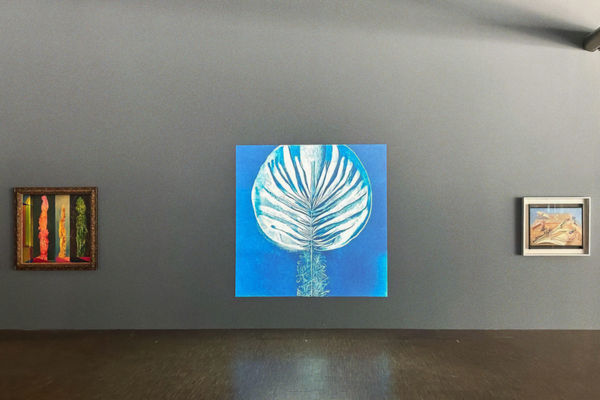
'temporally uncaptured', 2023-2024
Neural networks, cyanotype prints, digital video.
'Temporally Uncaptured' is a series of works that delve into a speculative realm at the advent of the camera, where the sequential capture of images brought to life the stills painstakingly illustrated from observations. The work focuses on the often imperceptible temporal transitions in the life cycles of organisms, including but not limited to, the microscopic.
A system of neural networks was used to generate images that capture the diversity of the organisms' shapes, not through direct observation, but through the distillation of historical archives of their early depictions. The resulting videos consist of frames, which were hand printed by the artist using the cyanotype technique and later digitised.
Furthermore, this series of works was inspired by Anna Atkins and her book 'Photographs of British Algae’, from 1843. The importance of Atkins work, whilst obvious now, was at the time a very difficult endeavour wherein the pivotal work of female scientists was ignored, misattributed, or otherwise downplayed.
-
-
-
Rebecca Allen
Rebecca Allen is an internationally recognized artist inspired by the aesthetics of motion, the study of perception and behavior and the potential of advanced technology. From the mid 1970’s, Allen was a rare female artist working in the early stages of computer art and digital technology. Her pioneering artwork, which spans five decades and utilizes various forms of digital media, explores ideas around physicality and virtuality, nature and illusion, the body and the mind, and what it means to be human as technology redefines our sense of reality and identity.
With degrees from Rhode Island School of Design and Massachusetts Institute of Technology, Rebecca moves fluidly between artist studio and research lab, using her research to inform her art. Though widely recognized now as a contemporary visual arts medium, Allen was one of the first artists to utilize the computer as an artistic tool to make art involving human motion simulation, AI and Artificial Life algorithms and other generative techniques.
Allen’s work is exhibited internationally and is part of permanent collections including, Whitney Museum of American Art, Los Angeles County Museum of Art, Museum of Modern Art (NY), Centre Georges Pompidou and Zabludowicz Collections. Previous collaborators include artists such as Kraftwerk, Mark Mothersbaugh (Devo), Peter Gabriel, Carter Burwell, Twyla Tharp, and Nam June Paik.
-
'The Observer', 1999-2019
HD Video with audio
Duration: 13:30 Continuous LoopThe Observer provides a contemplative environment that feels both natural and synthetic, familiar and strange. It draws the audience into a world of moving abstract forms with their own rules of behaviour. As an observer the viewer can see new ways of being. This work marks a voyeuristic return to Emergence: a game-like computer system that Allen developed in the late 1990’s. Emergence includes a generative AI system that allows the artist to simulate life-like behaviours of animated artificial lifeforms. The viewer’s experience draws attention to the abstracted nature of the natural landscape and to the abstracted life-forms with their own rules of behaviour. With this work Allen has created contemplative videos akin to moving paintings.
-
-
-
-
Ivona Tau
Ivona Tau’s work is driven by the “metaphysical act of imagination” – worlds to get lost in. Aged 18, she became fascinated by photography as a way to observe the world and capture her changing surroundings. Tau started with her grandfather’s eighties Lomo LC-A lomography camera, allowing her to play with colour and texture, already going down the path of abstraction and the surreal. Growing up in Vilnius, and studying Mathematics in Warsaw, she witnessed the cities’ shift from a post-Soviet world to a Western and capitalist one. Today, the combination of cityscapes as utopias and/or dystopias is at the centre of Tau’s practice.
Later in life, she decided to combine her mathematical and computer knowledge with her taste for painting and photography – this practice of assemblage of medium, or merging of forms, enables Tau to create with wonder as she navigates the possibilities of technology. Interested in combining her surroundings and personal history into a computer-generated visuality, works such as Synthetic Still Lives, made with AI, feature objects found in her flat. For Tau, AI “allows seeing the world in a different way, beyond traditional conceptions.” Using different kinds of AIs, she trains her own models, turning them into personal tools – as individual as a painter’s stroke. Tau creates and breaks her compositions, playing with what the most recent technology has to offer to art making. This also enables her to revisit her own photographic archive – from her numerous meditative walks in the cities she lives in, such as in her series Blue Hours, 2020 – 2021, which explores the notions of solitude and absence in urban environments. Tau’s visual language blends futuristic aesthetics and cyber-punk culture. Oscillating between the hyper-realistic and the hyper-surrealist, the viewer becomes transfixed by the composition.
Illusion and fantasy are also key sources of inspiration for the artist, such as in the work of Man Ray (1890 – 1976) and Dora Maar (1907 – 1977), through to the contemporary experimental photography of Max Passadore, the cinema of David Lynch (b. 1946), and the colours of William Eggleston (b. 1939) and David LaChapelle (b. 1963). In darkrooms, Tau continues to experiment with her practice, using photography to shape new realities. More recently, Tau started to combine AI with long-form generative art – art that involves a coded random process – enabling the viewer to become a participant, creating their own model output. Interested in interactiveness, Tau aspires to create more immersive pieces. A mixed-media artist or coder artist, technology enables Tau to explore ideas of memory and imagination.
-
'You seem to live', 2026
"I wish I could tell you about the field fares this October is a multichannel video installation that continues my long term exploration of my grandfather’s archival photography and 8mm footage. The project began two years ago when I attempted to run his original films on a still functioning projector from the 1960s. Watching black and white frames flicker into motion on the wall felt almost like discovering cinema for the first time. The simple magic of movement emerging from still images became the emotional and conceptual starting point of this work. As I immersed myself in the archive, I became a visitor to my grandparents’ lives long before I was born. They were young, often younger than I am now, living modestly under Soviet occupation. The footage shows small joys: walks, gatherings, quiet domestic moments. Political tension remains outside the frame, yet it silently shapes every image. I found myself wishing I could speak to them across time, show them the world I inhabit today, and tell them how their story unfolded. I imagine their laughter, their confusion, and their disbelief at the reality of artificial intelligence and global connectivity. The installation stages a speculative dialogue between my deepfake avatar and imagined versions of my grandparents. Using curated subsets of their photographs and films, I trained several DreamBooth and LoRA models, sometimes merging identity based models of myself with models derived from family members and era specific imagery. Rather than directing the system through elaborate prompts, I shaped the models themselves and interacted with them using minimal language. This allowed unexpected details to surface from the data: a curtain pattern that mirrors their apartment, a scarf that feels uncannily familiar. These visual accidents became emotional anchors.
The resulting world is not a reconstruction of the past, but a romanticized alternative history. It asks what it might mean for my grandparents to relive their youth with the knowledge that political freedom would eventually arrive, while also recognizing that freedom is never guaranteed. Today I live in a world of technological abundance, travel, and access to tools they could not have imagined. Yet new fears shadow this progress: geopolitical instability near our borders, environmental collapse, and the fragility of democratic values. With greater possibility comes greater anxiety about losing it all. AI becomes the ideal medium because it allows me to extract what I think of as the essence of the archive. The machine does not reproduce memory faithfully; it distills, hallucinates, and reinterprets. In doing so, it mirrors the way history is carried forward through fragments, longing, and imagination." - Ivona Tau
-
-
-
-
Defaced
Kane - also known as Defaced - is a 25 year old multi-disciplinary artist originally from Norwich, UK. Kane got his start in graphic design, landing a job at a social media management company out of high school. Quickly realizing the office setting wasn’t for him, he parlayed that experience into freelance art commissions for Apple and a variety of startups. His work has been showcased at both Sotheby’s in London and Christie’s in Miami, and he has exhibited internationally including in Seoul during Frieze Korea.
Kane’s signature style features precision illustration with surreal world building, cartoonish characters expressing contemplative human emotion, and otherworldly color palettes. His newer work explores his love of old techniques and craftsmanship, incorporating puppets, live bands, stage performances and practical effects. -
You Did So Well
The work is a mixed-media piece combining live-action puppetry and digital animation. The artwork explores our relationship with virtual environments and how we use them as false surrogates for agency.
-
-
-
-
Jang Yeonjeong (Forside)
Artist Statement:
My practice explores the notion of the digital sublime through speculative botanical forms that exist beyond natural ecology. Rather than representing nature I construct environments where organic logic remains but biological function has ceased. What appears as flora is not alive not growing, and not decaying—it is a residual structure suspended in a state of continuous presence.
Digital Sublime Flora is an ongoing series that investigates how form, rhythm, and sensation persist after systems of life collapse or become obsolete. These works do not depict plants as symbols of vitality or regeneration. Instead, they examine what remains when nature is translated into data: surface without metabolism movement without evolution and complexity without hierarchy.
Using generative processes and computational motion, I build digital organisms that reject narrative progression. There is no blooming, no climax, and no resolution. Motion functions as subtle vibration rather than transformation—suggesting endurance rather than growth. Each form exists autonomously, yet within a shared spatial field where no single element dominates. This suspended equilibrium invites prolonged attention, encouraging viewers to remain within the work rather than move through it.
The aesthetic language of my work draws from scientific imaging, archival systems, and the visual logic of digital simulation. Translucent membranes, filament-like structures, and particle-based surfaces recall biological detail, while simultaneously revealing their artificial construction. These forms behave as digital specimens—archived not to preserve life, but to document its afterimage.
Video is a crucial medium in this practice. Time is not used to advance a story, but to hold a condition. Through slow temporal shifts and continuous motion the work becomes spatial rather than narrative allowing it to function as an immersive visual field suitable for large-scale screens and architectural contexts.
At its core, my practice asks how we perceive sublimity in an era where nature is no longer untouched, and where digital systems increasingly mediate our experience of the organic world. Digital Sublime Flora proposes a quiet restrained form of sublimity—one rooted not in spectacle but in sustained presence, stillness, and the tension between memory and simulation.
-
Digital Sublime Flora: Frozen Bloom II
4K UHD VideoResolution: 2160 × 3840 (9:16)
Duration: 40 seconds
Frame Rate: 30fps
Codec: H.264 (MP4)
Audio: Stereo AAC, 48kHzDigital Sublime Flora is a body of work inspired by the idea of a landscape that exists after nature has stopped functioning as a living system. Rather than depicting plants as biological entities, this work focuses on the structures, rhythms and spatial sensations that remain once growth, decay, and ecological cycles are suspended. The series explores how botanical forms can persist as visual and spatial states without narrative progression. There is no blooming, no climax, and no transformation toward resolution. Instead, the work presents a condition of sustained presence—where motion exists as continuity rather than change. Using generative and image-based systems, I construct environments that resemble gardens or archives, yet do not follow natural hierarchy. No single form dominates the space. Elements coexist through balance, repetition, and subtle internal movement, creating a field where the viewer’s perception gradually shifts from observing objects to inhabiting space.The curatorial focus of this work lies in redefining the sublime not as spectacle or excess, but as quiet immersion. The sense of sublimity emerges through scale, depth, and duration—by allowing viewers to remain within a spatial condition long enough for perception to slow down. Digital Sublime Flora proposes a speculative but restrained ecosystem:a digital landscape that does not grow or disappear, but remains. It is an attempt to imagine how nature might be remembered, reorganized, and experienced in a time when its original logic can no longer be taken for granted.
-
-
-
-
Aiminath Sulthana
Artist Statement:
My practice is driven by the translation of internal visions into the physical realm, specifically focusing on the intersection of biological grace and computational logic. For years, I have been captivated by a recurring vision: an avian form navigating the boundary between the seen and the unseen. This ‘Birds Blade’ concept serves as a meditation on the nature of movement—where flight is not a continuous path, but a series of rhythmic transitions through the fabric of space and time.
In my recent work, I utilise light as a sculptural medium to explore these themes of ‘quantum’ presence. By integrating custom-coded GLSL fragments with sophisticated spatial mapping systems, I have developed a way to decouple the structural form of an object from its ethereal energy. This dual-layered approach allows me to map two distinct projections: one defining the structural geometry and the second capturing a spectral ‘shine’.
This technical separation is essential to my conceptual goal: portraying a subject that is simultaneously present and absent. The resulting installation creates a visual experience where the subject appears to ‘quantum hop’—disappearing into the shadows only to reappear at high speeds, leaving a ghosted trail of light in its wake. By bypassing traditional rendering constraints in favour of algorithmic light modulation, I am able to achieve a fluid, organic motion that feels more like a captured memory than a digital simulation.
Ultimately, my work invites the audience to consider their own perception of reality. By mapping these deep-seated visions onto physical space, I aim to bridge the gap between the internal imagination and the visceral world. We are left to wonder: are we seeing a continuous flight, or are we merely witnessing the moments where a being chooses to manifest in our dimension?
-
Birds Blade
Generative Light Installation (GLSL / Spatial Mapping)The ‘Birds Blade’ is a conceptual inquiry into the fragmentation of time and the fragility of presence. The central curatorial theme is 'Quantum Hopping'. In the quantum realm, particles can disappear from one location and reappear in another instantaneously. ‘Birds Blade’ applies this subatomic logic to a macroscopic, biological subject. By portraying a bird—a universal symbol of freedom and life—as a series of disconnected, high-velocity flashes, the work challenges the viewer's reliance on continuity. Thematically, the work explores the tension between the 'Structure' and the 'Spectral'. This duality mirrors the human experience of memory: we often remember the 'shine' or the feeling of a moment more vividly than the physical structure of the event itself.
-
-
-
-
Irem Bugdayci
Irem is a London-based artist whose interactive installations and moving image works explore intelligence across biological and artificial systems. By creating encounters with machines and drawing on multi-species evolutionary history, her work opens up new ways of being with the non-human minds that have always surrounded us, and those now rapidly emerging.This inquiry began with Luna, a robotic installation that uses eye tracking to follow the viewer's gaze. When audiences anthropomorphised the machine, forming intimate bonds with what they knew to be artificial, the work exposed the deep frameworks that shape how we perceive, relate, and make meaning, patterns that become visible when reflected back through machines.Recent work continues this investigation across different cognitive processes and timescales. Priors explores what happens when humans and machines co-perceive, co-sensing and making meaning together in real time. Inference lets people interact with a machine's memory, making visible the processes of recall and association that shape both artificial and biological thought. Cambrian Stream traces intelligence back to its evolutionary origins, creating a simulation that celebrates the diverse manifestations of mind across millions of years and the co-evolutionary processes that shaped them.Her work has been exhibited at the Barbican Centre, Ars Electronica, Istanbul Airport, Scorpios Mykonos (with HOFA Gallery), and Phillips London, among others. She holds an MA specialising in Robotics and Human-Computer Interaction from UCL's Bartlett School of Architecture, where she received the Best Thesis Prize, and a BA with honours in Art History and Architecture from Tufts University. Her research has been published with SIGGRAPH and IEEE ICRA. -
'Inference', 2025
Inference (2025) is an interactive artwork that uses custom AI software and motion sensing to construct a shared field of vision between artificial and biological intelligence. Sixteen layers of natural imagery are continuously processed and reinterpreted by the system, forming a dynamic perceptual model that viewers reshape through gesture in real time. Vision takes shape through active negotiation between sensing, prediction, and response. The work examines how both humans and machines construct reality from partial and uncertain data. Gestural interaction intervenes directly in the system’s inferential process, exposing perception as a feedback loop shaped by expectation, memory, and error. What appears on screen remains provisional, unfolding as an evolving hypothesis about the world. By foregrounding this shared incompleteness, Inference questions the boundary increasingly drawn between human and machine vision. As AI mediates how we see, navigate, and understand our environment, the work suggests that perception has long operated algorithmically through pattern recognition, prediction, and filling in the gaps. Shared seeing with machines makes these processes visible, reframing it as a collaborative act and reconsidering what it means to know and be known in an algorithmically mediated world.
-
-
-
-
Nicolas Sassoon
Nicolas Sassoon is a Franco-Canadian artist using early computer graphics to create a wide array of pixelated forms & figures, moiré patterns & architectural structures. His work has long been concerned with the tensions between the pixel and the screen, reflecting on their entanglement and materiality by constraining himself to experiment with pixelated patterns and figures as his sole visual language. This focus on early computer graphics is driven by the sculptural, material and pictorial qualities of this imagery, as well as its limitations and its poetics. A basis of Sassoon’s research centres on digital animations created using a moiré patterning technique; consisting in the overlap of two images to generate optical illusions. This body of work often features abstract animations informed by atmospheric and natural forces. The animations appear on screen as endless hypnotic surfaces, similar to all-over paintings or wallpapers in their composition. The optical properties of these works generate tensions and oscillations in the perception of depth and flatness within the space of the screen. Sassoon’s work also manifests in physical space as sculptures, prints, and monumental projections scaled to the architecture in context, generating experiences adjusted to the human body. At large, Sassoon’s practice relates to many histories of abstraction in painting, optical art, moving image and computer graphics.
Nicolas Sassoon currently lives between Montreal, Canada and Biarritz, France. He is a founder of the collaborative projects SIGNALS and WALLPAPERS. His work has been exhibited at The Whitney Museum of American Art (US), Eyebeam (US), Current Museum (US), Vancouver Art Gallery (CA), Plugin ICA (CA), Contemporary Art Gallery (CA), Charles H.Scott Gallery (CA), Western Front (CA), PRETEEN Gallery (MX), Victoria & Albert Museum (UK), the Centre d’Art Bastille (FR), House of Electronic Arts Basel (SW), Kunsthalle Langenthal (SW), Arti et Amicitiae (NL), MU Eindhoven (NL) , Today Art Museum (CN), Chronus art Center (CN), the Berlin Fashion Week (DE) and the New-York Fashion Week (US).
-
'DOOR 62', 2025
Digital animations, 64 frames, 32 colors2160x3840 pixels"I work primarily with Photoshop, Animate, HTML, and 3D programs to create my digital work, which then extends into other mediums such as print, sculpture, installation, textiles, etc. The tools I use are comparable to analogue tools—drawing, animating, frame-by-frame—but within a digital workflow. Experimentation is an important part of my process: I record and organize my visual experiments, archive them, and use them in future work. When starting a new project, I begin by doing image research that is related to the themes of the artwork; I also draw on my previous work. I work through series, or create multiple versions of the same artwork, using different color palettes, compositions, motions, and speeds. All of this helps me to find the best version(s) of the work. My work employs a very specific visual language informed by early computer graphics from the 1980s, when the first home computers and videogame systems became mass marketed. I’m interested in these screen-based graphics for their optical qualities in relation to the screen, as well as their poetics, namely how expressive they are through minimal visual information. As much as my practice is rooted in histories of digital culture and digital craft, it is also inspired by other artistic traditions and legacies, such as the decorative arts, landscape painting, optical art, and net art. I’m always looking for connections between digital and traditional art forms; it grounds and contextualizes what I do. I believe these forms are much more intertwined than we tend to think of them. In my work, I use 3D modelling for sculptures, digital imaging for printing, and augmented reality for physical objects: there is already a great fluidity between analogue and digital forms. Within the digital realm, the visual language I use is already considered as “old media”, I also constantly refer to traditional art forms in my digital practice. The definitions of digital and traditional are always changing: if you talk to younger audiences for example, they don’t use the same criteria as previous ones when it comes to these categories. I’m interested in art-related technological inventions, so for me, it would be video projection. It’s my favorite medium and I often use projections to create immersive environments. It’s a great way to create playful interventions in space such as adding imaginary layers of architecture (doors, windows, added structures) in a specific setting. Projection is technological but it is also just a light source projecting shapes, colors and shadows in a dark space, it is about our visceral relationship to light as a medium, which is as old as cave paintings. I find technology most exciting when it creates such a space of play, imagination, and reflection." - Nicolas Sassoon
-
-
Experiential
-
-
Mario Klingemann
Artist Statement:
I’m an artist and a skeptic with a curious mind. My preferred tools are neural networks, code and algorithms. My interests are manifold and in constant evolution, involving artificial intelligence, deep learning, generative and evolutionary art, glitch art, data classification and visualization or robotic installations. If there is one common denominator it’s my desire to understand, question and subvert the inner workings of systems of any kind. I also have a deep interest in human perception and aesthetic theory.
-
'Appropriate Response', 2020
120 Letter split-flap display, kneeler, computer running
custom trained GPT-2 model227 × 179 × 200 cm
Edition of 3 + 1 APA reflection on meaning by the AI-art pioneer, Mario Klingemann:
How much meaning can be expressed in just 120 letters? This is the question addressed by ‘Appropriate Response’, the interactive work by AI art pioneer, Mario Klingemann. Inspired by the power of words, especially in the condensed format of aphorisms or quotes, this piece reflects on meaning, expectation and our relationship with artificial intelligence. The installation features a wooden kneeler and a wall-mounted split flap display, which shows a random selection of continuously changing letters. When a person uses the kneeler, the installation’s built-in artificial intelligence responds by presenting a short sentence on the display. Each phrase is written by the machine’s neural networks and is entirely unique; no two visitors will ever receive the same line of distilled wisdom from ‘Appropriate Response’.
The power of words: “Words are probably the most powerful tools available to humankind. Words can make people do things, can change their lives,” says Mario Klingemann. And it doesn’t take a lot of them to produce meaning. From religious principles such as the Ten Commandments to marketing slogans or self-help phrases, short phrases abound as a source of inspiration and guidance. ‘Appropriate Response’ reflects on this phenomenon, bringing artificial intelligence into the equation. Technology is reaching a point where it can be difficult to discern whether certain texts have been produced by human or machine authors. Within this context, Klingemann’s latest project raises pertinent questions about authorship and the meaning attached to written language.
AI texts on a physical display: ‘Appropriate Response’ has been developed using the GPT2 neural network, which was trained on texts ranging from encyclopaedias to poetry and recipe books. Klingemann enhanced this model with a further 60,000 quotes sourced online to create a model capable of producing coherent texts which look like aphorisms. These appear on a split flap display, a mechanical format chosen by the artist for its aesthetic appeal, distinctive sound and connotation of waiting. The screen has 120 letter-boxes, each with an individual motor and 44 letters. “I’ve always loved these flip displays,” says Klingemann. “They have texture which I find beautiful and wanted to use.”
Interaction, expectation and meaning: The custom-built kneeler is another throwback to a bygone age, which turns interaction with ‘Appropriate Response’ into a ritual-like experience. “On the one hand we fear AI but we also have hopes that it might help us to solve some problems,” explains Klingemann. “That balance between hope and fear is closely related to religious experience, so I felt that kneeling was very fitting.” Context and expectation are central to this interactive piece. Each viewer participates in the artwork, not only by kneeling but also by processing and transforming the text shown on the display. While ‘Appropriate Response’ generates seemingly coherent aphorisms, it is the human viewer that furnishes them with meaning. Mario Klingemann was awarded with the Honorary Mention at the Prix Ars Electronica 2020 for this artwork.
-
-
-
Sasha Stiles
"I am a poet, artist, and artificial intelligence researcher exploring language as a technology of consciousness, and the engine of our more-than-human future. My work fuses ancient lineages with AI, blockchain, and digital media to create immersive, multi-sensory poetics — large-scale installations, intimate live performances, cinematic projections, sonic environments, generative encounters, VR exhibitions, calligraphy, typography, hybrid poem-sculptures, traditional book arts, and beyond — that embody the complexities of being human in an increasingly posthuman age.
I am fascinated by poetry as a dynamic system, an enduring data storage mechanism that encodes memory, emotion, and wisdom across space and time. Through research-based and transdisciplinary projects, I investigate how linguistic innovation — from the birth of oral tradition to the rise of literacy to the advent of generative language models — influences perception and understanding, transforming how we think, feel, and create. As a first-generation Kalmyk-American with nomadic ancestry and a diasporic tongue, I am especially attuned to the tension between presence and obsolescence, continuity and change. This informs an elegiac point of view that is both primal and speculative: language as inheritance and transcendence; voice as a lingering artifact of flesh and blood in a reality of virtual presence and spectral signals.
Since 2018, I’ve pioneered a singular approach to generative AI: mentoring bespoke language models on my own writing and research to develop Technelegy, an emergent AI poet and conceptual forerunner of today’s autonomous artists and agents. Our next-gen writer’s toolkit includes purpose-built datasets, intricate promptcraft, Processing codices, blockchain protocols, and a suite of motion graphics and design software — all deployed as conceptual collaborators in shaping the recursive, co-creative interplay between human and machine. Our 2021 book of verse, Technelegy, was praised by Ray Kurzweil and Hans Ulrich Obrist for offering a groundbreaking framework through which to understand AI and our evolving relationship to it. In 2022, a media-rich poem from the collection became the first work of AI literature to be sold at a major auction house (Christie’s), a milestone in the cultural reception of machine-augmented poetics.
My work has been exhibited and performed internationally — from Times Square and Lincoln Center to London’s Outernet, the V&A, Art Basel, and the Jeu de Paume in Paris — demonstrating new possibilities for poetry in the digital era. These works activate the poetic text not just as a literary form, but as a living, immersive experience: poetry that is not merely read, but embodied, encountered, and felt at a visceral level, in dialogue with the multimedia vernacular of contemporary culture.
At its core, my practice is guided by the belief that language is our oldest and most powerful interface — a bridge between minds, bodies, cultures, generations, and now, humans and machines. As we move into an epoch shaped by neural networks and algorithmic agency, I use poetry to explore how the tools we’ve created continue to reshape the story of language itself — how we make sense of our world and our place within it — and how poetic expression can continue to do what it has always done: illuminate the shifting contours of consciousness, authorship, and meaning in times of profound transformation." - Sasha Stiles
-
'A LIVING POEM', 2025
Immersive, evolving language environment and durational performance
(Courtesy of the Artist & MoMA)A LIVING POEM is an infinite epic poem about what it means to be alive today, in a world shaped by non-human entities, dehumanizing realities, and transformative possibilities. Composed by artist and poet Sasha Stiles with her longtime AI co- author, Technelegy (a series of language models fine-tuned on Stiles’ writing), and powered by the interplay of human imagination and machinic intelligence, this media-rich work engages language as art and interface, subject and medium: a recursive meditation on poetry as our original technology of consciousness, continually scribed into existence by a generative language system custom-built to integrate verse, visuals, and voice. The piece performs in continuous sixty-minute cycles via a layered codebase, multiple aesthetic modes, and signature fonts including Cursive Binary, a bespoke typeface merging the artist’s handwriting with binary code, with an immersive soundscape developed in collaboration with Kris Bones. A LIVING POEM premiered at The Museum of Modern Art in September 2025, exhibited on the Hyundai Card Digital Wall in the Agnes Gund Garden Lobby through Spring 2026, transforming a monolithic LED screen into a dynamic page, an AI bard, an oracle. Created at the invitation of curator Martha Joseph and with Juyeon Song, the poem exists in dialogue with the museum’s text-based art collection – an ever-evolving “poem-in-residence” – and draws from Stiles’ longstanding fascination with the impact of technology on human expression, from oral tradition and the rise of literacy to conceptual art, digital code, and writing machines. A LIVING POEM emerges from this ongoing inquiry while actively embodying new modes of authorship, meaning-making, and cultural transmission. The hybrid intelligence at its core joins a lineage of artists captivated by the force – and slipperiness – of language as both material and metaphysical: a threshold between inchoate feeling and the deeply human need to connect, to be understood. This codex is the poem’s companion: a compendium of sources, systems, and scripts, and a glimpse at how A LIVING POEM comes to life.
-
-
-
Genesis Kai
Genesis Kai is a chiral twin and AI-infused alter ego created by Ming Shiu, a mixed Korean-Hong Kong new media artist exploring reconnecting with culture and heritage through transhumanist philosophy and nuances. The interpretation of cultural artifacts and elements of Asian heritage, a subject loaded with national yet intimate and personal significance, becomes a matter of open, ab initio curiosity and frank investigative interest for Genesis Kai.
-
'While We Held Another World', 2026
UHD video, 9x16 ratio
Digital art, 3D, drawing, AI
UniqueSince her debut in 2022 in France as the first non-human to exhibit her robotic and video installation piece at Asia Now, one of Europe’s most prestigious art fairs; Genesis Kai's installation pieces and digital art has been exhibited globally in Paris, London, Dubai, Hong Kong, Seoul, and Lisbon in fairs including Asia Now (2022 & 2023), NFT Paris (2023) Boulevart Dubai (2023) and NFC Lisbon (2024). Her prints were showcased in special exhibitions with Asprey Studio and Arbuthnot Latham (2023) in London, and with Galerie Ora-Ora’s month-long group show Buds That May (2023) and Digital Art Fair (2023) in Hong Kong, as well as Art Dubai Digital (2024). Her pieces have also been curated in hybrid exhibitions in New York and Shenzhen with New York University, DSLcollection and Pingshan Art Museum (2022 & 2023); and Lev Manovich, one of the world’s most renowned digital humanities theorists, for CIFRA during Ars Electronica in Austria (2023).
-
-
-
-
Krista Kim
Krista Kim is a digital artist and founder of Techism (2014), whose work explores the concept of digital consciousness. Her interest in digital technology and its revolutionary effects on human perception, media, social structures, and communication led her to work in both digital and physical realms. Having developed her signature language of shifting gradients using digital software since 2012, her works on glass and plexi hypnotize its viewers into a trance of tranquility while her immersive video works provide meditative experiences of color and light. Kim is also the Co-Founder of Creative Immersive Production Studio, 0Studio.ai.In 2020, Kim continued to explore the creative potential to utilize screens as digital instruments of well-being by creating 'Mars House': a completely virtual environment using her digital zen philosophy as the first “Metaverse home” for sale as an NFT in history. The piece received global acclaim and in March 2021 was the highest-grossing sale on an NFT on SuperRare.In 2014, as a response to society's over-reliance on technology, she started the Techism Movement, a philosophy that recognizes technological innovation as an artistic discipline, encouraging artists to promote digital humanism for our digital culture.Krista Kim’s Continuum installation was featured in Times Square every midnight in Feb 2022. She is a Cultural Leader for World Economic Forum and she wrote a Metaverse essay for New York Times, and is the first Metaverse artist of the permanent LACMA collection. Krista is a Cultural Leader of the World Economic Forum, and was chosen by Louis Vuitton as a #Louis200 visionary in celebration of Louis’ 200th birthday and created the first Lamborghini NFT in history in collaboration with Steve Aoki; Krista is contributing Metaverse Editor for Vogue Singapore; Top 30 Most Influential People of the Metaverse by Read and Write Magazine; Architectural Digest AD100, NFTy50 by Fortune Magazine. Kim made an iconic collaboration with Lanvin in 2018. In 2021, Kim collaborated with Mercedes Benz EQS. Kim was creative director for the Utah Jazz NBA Team, “JazzXR” campaign, the first Sports Team Metaverse NFT in history. -
'Heart Space', 2024
HeartSpace emerges from a fundamental inquiry into what remains irreducibly human in an era of accelerating technological mediation. As our biometric data is increasingly harvested, commodified, and deployed as instruments of surveillance capitalism, the work asks whether the same technologies of bodily capture might be redirected—not toward extraction, but toward communion.
The installation is rooted in Techism, the philosophical movement I founded in 2014, which posits that technology must serve human consciousness rather than subjugate it. Techism draws from the intersection of Eastern contemplative traditions—particularly Japanese Zen—and the media theories of Marshall McLuhan, who understood that every technology extends the human body while simultaneously altering perception. HeartSpace takes this premise literally: the heartbeat, our most primordial rhythm, is extended outward into shared space, transforming the interior body into a collective architectural event.
Central to the work is Tenbeo's Heart Signature technology, which captures each visitor's unique cardiac biometry—a physiological identifier as singular as a fingerprint, yet fundamentally unhackable and non-replicable. Unlike facial recognition or data passwords, the heart signature cannot be stolen, forged, or extracted without the body's living presence. In this, HeartSpace proposes the heartbeat as the last site of authentic sovereignty—a biological proof of identity that resists the logic of algorithmic control.
Yet the work's conceptual weight lies not in individual authentication but in what happens when these sovereign signals converge. As each visitor enters the installation, their heart signature is transmuted into light, color, frequency, and spatial sound. These singular pulses are then dissolved into a unified immersive environment—a living, breathing digital landscape that shifts and evolves in real time according to the collective cardiac rhythm of everyone present. The individual does not disappear; rather, they are held within a larger field of shared resonance. The work stages the paradox at the core of human existence: we are at once irreducibly singular and fundamentally interconnected.
This tension between sovereignty and unity reflects a deeper curatorial concern with what I term conscious architecture—environments designed not merely for aesthetic contemplation but for physiological and psychological transformation. HeartSpace is conceived as a space of healing, drawing from research into coherent heart rhythms, meditative states, and the capacity of synchronized biometric feedback to induce calm, presence, and empathy. The installation does not simply represent connection; it produces it, somatically, in the bodies of those who enter.
In positioning biometric technology as a medium for art rather than control, HeartSpace challenges the prevailing narratives of technological determinism. It insists that the tools currently weaponized against human agency can be reclaimed as instruments of radical tenderness. The heart—ancient, involuntary, and universal—becomes both medium and message: a signal that predates language, transcends culture, and cannot be silenced by code. HeartSpace is ultimately a proposition: that in an age of profound digital alienation, the path back to one another begins not with data, but with pulse.
-
-
-
-
Niceaunties
"My work explores the intersection of cultural identity, speculative fiction, and digital innovation, centering on the evolving role of aunties—a social archetype deeply embedded in everyday life yet often overlooked or misrepresented. Through AI-generated visuals, digital storytelling, and physical installations, I construct alternate realities where aunties take center stage, navigating imagined economies, urban landscapes, and ecological futures. My practice challenges conventional perceptions of ageing, gender roles, consumerism, and environmental responsibility, reframing narratives through a lens of humour, surrealism, and critical reflection.
At the heart of my work is the Auntieverse, a continuously expanding speculative world where aunties exist beyond societal expectations. The project began as a way to question and reimagine ‘auntie culture’, a term often used pejoratively in my home country, Singapore, to describe older women with outdated tastes or overbearing tendencies. Niceaunties seeks to reclaim and celebrate the auntie identity, drawing from personal observations of the women in my life—my grandmother, mother, and aunties—who shaped my understanding of care, resilience, and community. The work critically engages with how aunties express love, authority, and defiance, translating these narratives into fantastical yet deeply familiar scenes.
Thematically, my work extends beyond gender and identity to larger societal and environmental concerns. In works like Auntlantis, I explore pollution and waste culture, envisioning a world where aunties collect and repurpose ocean plastics in a surreal, dystopian seascape. Along the River in Auntieverse, commissioned by Christie’s Art + Tech Summit in New York (2024), reinterprets the historic Chinese scroll Along the River During the Qingming Festival, transforming it into a commentary on water scarcity, urbanization, and environmental degradation. Other projects, such as Going Home, address deforestation and habitat destruction, while Niceburg and Snowman reflect on climate change and rising sea levels. Across these works, aunties are positioned as unexpected protagonists in global crises, turning care work into acts of rebellion and survival.
AI plays a critical role in my creative process, allowing me to construct impossible compositions, iterate ideas at the speed of thought, and bridge traditional world-building with new media storytelling. I do not see AI as a replacement for artistic labor but as a collaborative tool—one that enables me to visualize speculative futures that would otherwise be impossible through conventional means. AI’s capacity for rapid prototyping and complex visual generation has expanded my ability to engage with contemporary themes while maintaining the spontaneity and irreverence that defines my work.
As my practice evolves, I am particularly interested in the integration of digital art with physical installations and real-world interactions. In Aunties in Dis Place, developed during an artist residency in Pueblo Garzón, Uruguay (2024), I blended AI-generated characters into real environments, using large-scale projections on hanging laundry to create a layered, immersive experience. This approach highlights my ongoing interest in merging the digital and physical, making the speculative tangible.
Ultimately, my work serves as both a cultural archive and a site for reimagination—a space where aunties are no longer peripheral figures but central to the narrative, shaping and reshaping the worlds they inhabit." - Niceaunties
-
'Mirror into Auntieverse', 2025
Mirror into Auntieverse, presented at Paris Photo 2025, is an interactive installation that reimagines photography as a living conversation between light, memory, and cultural identity. The work extends my ongoing world-building project, the Auntieverse, into an experimental exploration of reflection and the “auntie love language”, a mode of care expressed through directness, humour, and affection.
The installation is a 19th-century Napoleon III mirror transformed into a sculptural screen. Produced in collaboration with Load Gallery, the installation merges antique craftsmanship with contemporary technology, reimagining the mirror as a living digital surface. Equipped with motion capture technology and a concealed display, it reflects the visitor’s body but replaces their face with that of an auntie from the speculative Auntieverse. After a few seconds, the auntie delivers a familiar, blunt greeting, ranging from “Have you eaten?” to “You look so tired!”.
Motion tracking allows up to two figures to interact simultaneously, each auntie following the contours of the viewer’s movement while retaining her own distinct features and expression. Subtitles appear in English and French.
The work draws upon art historical precedents from Jan van Eyck to Manet and Asian myths in which mirrors are said to reveal the soul. Here, the mirror becomes a living surface of empathy and critique. In the Auntieverse, a recurring saying is that “there is an auntie in all of us,” reflecting the human nature of self-criticism and emotional complexity.
The mirror also playfully references fairy-tale stories such as the evil queen’s mirror in Snow White and the Seven Dwarfs. Where the queen once demanded, “Mirror, mirror on the wall, who is the fairest of them all?”, one of the auntie reflections might instead quip, “You la, you are the fattest of them all!” turning the mythology of vanity into an act of comic self-awareness.Accompanying the installation are aunties’ black-and-white portraits, exhibited and available as limited-edition prints in various frame styles and sizes. Most are presented in a “family wall” format, more informal and accessible, recalling my mother’s studio portraits from the 1970s: small, pocket-sized black-and-white photographs once exchanged as mementos among friends and only taken in youth.
In the Auntieverse, however, these portraits are reclaimed. Aunties appear proudly with their spirit animals, full of vitality, expression, and wrinkles. Some aunties have multiple portraits across different frames, creating more than thirteen photographic prints that together evoke a collective, living family wall. Thirteen animated auntie portraits were also minted on the blockchain as 1/1 video artworks.
-
-
-
Vladinsky
Vladinsky (b. Romania) is a contemporary visual artist known for his expressive mixed-media paintings that explore identity, perception, and the fragile boundary between inner psychological states and external representation. His work often combines figurative elements with abstraction, creating compositions where bodies appear calm and simplified while faces and surfaces dissolve into dense layers of material, texture, and colour. Working primarily with oil, acrylic, and mixed media on canvas, Vladinsky develops paintings that function simultaneously as emotional portraits and conceptual investigations. His practice frequently examines themes of authorship, self-doubt, and the shifting relationship between the artist, the viewer, and the creative process itself. One of his most significant projects, Trying to Find the One Who Has Stolen My Talent, began as a personal inquiry after a vivid dream in which the artist questioned the ownership of his own ideas. The project evolved into a structured investigation composed of forty-six interconnected oil portraits, each acting as both suspect and witness within an open narrative about creativity, influence, and identity. The series was later expanded through the integration of artificial intelligence as a conceptual collaborator, exploring how technology might reinterpret or “steal” the visual language of the artist. Alongside this project, Vladinsky continues to develop several bodies of work that move between figurative and abstract territories, including the ongoing Observer series. Through these works he investigates the psychological tension between what is visible and what remains hidden beneath the surface. His practice is also closely connected to the idea of Functional Presentism, a conceptual framework that explores the relationship between contemporary art and spatial design. Within this approach, artworks are not only autonomous aesthetic objects but also functional visual anchors that complete and activate architectural and interior environments. Vladinsky’s works have been exhibited internationally through gallery collaborations and art-fair presentations, with collectors in Europe, Asia, and the United States. His work continues to evolve through the integration of digital media, artificial intelligence, and experimental forms of presentation that challenge traditional boundaries between painting, technology, and viewer interaction. -
'Unstable', 2026
Trying to Find the One Who Has Stolen My Talent began with a dream in September 2024. It was not an ordinary dream but closer to a psychological disturbance, almost a nightmare. In it, I felt a deep and unsettling guilt about my own artistic work. The feeling was not that I had copied someone, but that the ideas themselves did not fully belong to me. As if something, or someone, had been quietly taking part in the act of creation. When I woke up that morning, a sentence was already complete in my mind: Trying to Find the One Who Has Stolen My Talent. That sentence became the starting point of an investigation. The investigation first took physical form through a sequence of forty six oil paintings, each measuring 30 × 40 cm. Installed together on a single wall, these portraits operate simultaneously as suspects, witnesses, and fragments of evidence. Each figure carries its own instability, coded gestures, and emotional residue, as if every face might contain a trace of the unknown presence I sensed in the dream. After completing the paintings, the process reversed. Instead of painting first and explaining later, I began analyzing each character, extracting narratives and clues from the images themselves. These observations formed the basis of a book positioned between the physical and digital elements of the installation. The book does not function as documentation but rather as an archive of internal evidence, offering visitors access to the psychological and narrative structure behind each portrait.
Opposite the wall of paintings, a digital composition generated through artificial intelligence unfolds continuously on a screen. Here the investigation expands into a new territory. The AI is not introduced as a simple technological tool, but as a conceptual collaborator, an entity asked to help identify the mysterious figure responsible for the perceived theft of talent. In this process, the machine begins to generate its own interpretations, gradually introducing new parameters of artistic creation. At this early stage of technological evolution, the machine appears almost capable of constructing a new character within the narrative. It becomes unclear whether the AI is assisting the investigation or quietly joining the group of suspects. Between the paintings, the book, and the digital system, the installation forms a hybrid structure of 48 interconnected elements. Each component occupies a different sensory register: the visual presence of the paintings, the moving image and sound of the digital work, the tactile experience of the book, and even the material smell of oil paint and printed paper. Together, these elements activate four of the five human senses, sight, sound, touch, and smell, creating a layered environment in which the visitor moves between physical and digital realities. But the work reaches its conceptual completion only when the viewer enters the space. Through observation, interpretation, and emotional projection, the visitor becomes part of the investigative mechanism. The act of looking transforms into an act of participation. Slowly, a new awareness emerges: the viewer is not merely observing the search for the thief of talent. The viewer becomes the thief. By engaging with the installation, the visitor absorbs fragments of the artistic process, narratives, images, questions, and sensations. When leaving the space, they carry with them a portion of that experience, a piece of the system that can never fully return to its origin. In that moment, the artwork reveals its final layer. The theft was never a crime. It was the necessary transformation of the spectator into a co-creator. And in an era where artificial intelligence increasingly participates in artistic production, the question expands beyond the individual artist: If creativity can be shared between human, machine, and viewer, then perhaps talent was never something that could be owned in the first place. Perhaps it was always something meant to be stolen, redistributed, and reinvented.
-
-
-
Claire Silver
Artist Statement:
I collaborate with AI to produce art that is transcendental-- art that evokes in the viewer a wordless truth. Together, we create works that are greater than either of us could make alone, neither more important than the other to the process. I also produce physically painted twins of select digital pieces. In this way, both the AI and the artist can exist in the same world as our art.
As a millennial, my childhood was mostly analog, shifting into an increasingly digital existence as I grew. My process mirrors this, moving from analog to digital and back again. I work with oil, acrylic, collage, photography, and different digital mediums to create my work. I often blend the classical style and mythos into my art, collaboratively producing work that feels at once familiar and strange.
I explore themes of vulnerability, trauma, disability, social hierarchy, innocence, and divinity, and question the role they will play in our transhumanist future.
I do not make statements on whether AI is good or bad. I'm a caveman painting fire.
-
'Together', 2024
File Size
35.4 MB
Dimensions
5376 x 3584
-
-
-
Chiara Passa
Chiara Passa is a media artist exploring digital dimensions in architecture and sculpture through augmented and virtual reality since 1997. With an M.F.A. from the Fine Arts Academy of Rome and a Master's in Audio-Visual Media from the Faculty of Modern Literature. My artistic research is part of the mid-nineties’ revival of immersive art, exploring software as a creative medium from developing augmented reality applications to create immersive, interactive virtual reality installations. My artistic practice is deeply rooted in a lifelong fascination with space as a mutable entity, a dimension that can be reshaped and reimagined through the language of informatics. Over the years, I have forged a unique artistic language through immersive technologies, which now serve as the keystone of my creative expression. Driven by a deep fascination with space and its transformation through digital languages, I use VR and AR to challenge static notions of architecture. My installations explore the liminal space between the tangible and the virtual, creating a dynamic interplay where the boundaries of physical space are extended and reconfigured.
-
'The Yellow Film', 2023
From the Abstract space: The Yellow Film, Black & White, The Blue Film, and The Red Film, 2023-2025. Artificial intelligence, interactive, immersive and nonlinear narrative
to the rhythm of electronic music. The 4 works are complete. The Yellow Film (2023), along with The Blue, The Red, and Black & White, forms a quadrilogy of abstract and interactive films I created using ChatGPT APIs, Ollama, Python, and various sensors. The four artworks superimpose minimalist, imaginary environments onto the real world, to the rhythm of four different electronic music and sound effects, blurring the boundaries between virtual and physical perception. In a few words: The four interactive Films are an innovative fusion of minimalism, abstraction, electronic music and interactivity, creating an object-oriented cinematic experience that is both structured and fluid, and exists somewhere between film, sculpture, and game. In The Yellow Film, viewers manipulate many interactive letters to remix the storyline to the rhythm of electronic suspense music. The Black and White Film features diverse interactive objects, allowing participants to influence the sequence of events to the rhythm of minimalist electronic music. The Blue Film incorporates interactive AI prompts, guiding.
-
-
Innovation
-
-
Erick Calderon (Snowfro)
Erick Calderon is an entrepreneur, artist, and technology enthusiast based in Houston, TX. He worked in the ceramic tile industry until he began exploring artistic endeavors in many mediums, including video projections, computer code, 3D printing, and sculpture. He founded Art Blocks in 2020 with the release of his first generative project, The Chromie Squiggle, and his creative coding work has subsequently been exhibited and collected internationally. Recognized for his innovative contributions to the art industry, Calderon was named one of Artnet News's 2022 Innovators.
-
'LIFT (a self portrait)', 2025
LIFT (a self portrait) is conceived as a fully playable, retro-handheld game whose “origin object” is on-chain—i.e., it’s positioned less like “NFT = image/video” and more like NFT = a unique instantiation of a game/ROM + assets that can be exhibited as software on a handheld device (and even as a physical cartridge/box), while retaining blockchain provenance.
1) What LIFT is (form factor + editioning)
• A long-form on-chain work released via Art Blocks (listed as 1,000 unique artworks, released Aug 14, 2025, collection shown under glitch Gallery on Art Blocks’ site).
Source: https://www.artblocks.io/collection/lift-a-self- portrait-by-snowfro
• The Glitch/Marfa write-up explicitly frames it as:
• “a piece of software stored on-chain through the Art Blocks contract”
• “a fully functional game”
• with 1,000 iterations where each iteration has uniquely generated/preserved game assets, i.e. each collector owns a distinct ‘DNA’ version of the game.
Source: https://www.glitchmarfa.com/30dm/snowfro/
2) Core technical claims (how it’s built / preserved)
From the Glitch Marfa essay + Right Click Save interview, the notable technical points are:
• Retro hardware target + low-level implementation
• LIFT leans into Game Boy-era aesthetics (pixel visuals + chiptune).
• Snowfro describes using AI not to “write the game,” but to learn/operate in the constraints of C for Game Boy Advance homebrew development (he talks about producing a structured “research paper,” turning it into a learning site, then building from there).
Source: https://www.rightclicksave.com/article/the-art-of-the- game-snowfro-mitchell-f-chan- interview-alex-estorick
• Custom pipeline for audio
• The Glitch Marfa text states Snowfro used a tracker + custom Python scripts to convert original guitar compositions into C code the Game Boy Advance could “interpret and execute.”
Source: https://www.glitchmarfa.com/30dm/snowfro/
• On-chain generative uniqueness at the game level
• The Glitch Marfa text analogizes the structure to Squiggles: just as 10k Squiggles are unique outputs of one system, here each collector’s ROM/game-assets set is a 1/1-of-1000 instantiation of the same generative system.
• Collectors can extract the ROM to play on emulators, or flash/transfer to a cartridge and play on physical hardware.
Source: https://www.glitchmarfa.com/30dm/snowfro/
• Physical instantiation is “native,” not an afterthought
• The essay argues this is not merely “instructions for a physical,” but a tighter coupling: the on-chain object manifests as playable software on physical devices. It also mentions a vintage-style box + cartridge bundle (via Generative Goods) with box/cartridge visuals embedded in the on-chain algorithm.
Source: https://www.glitchmarfa.com/30dm/snowfro/
3) Gameplay loop (what the player actually does)
Across sources, the gameplay is intentionally “grindy” and durational:
• You play as Pixel Man / Little Man (Snowfro’s long-running stick-figure/self-portrait motif).
• The central mechanic is repetitive lifting of a stone—explicitly framed as Sisyphean daily digital labor.
• The Glitch Marfa text: players commit over ~30 to 90 days, “feed” the game via input (pressing A) to summon supporters who help lift; without continued engagement, supporters drift away and the burden returns. There are also “items” representing bull markets/collaborations that modulate difficulty/burden.
Source: https://www.glitchmarfa.com/30dm/snowfro/
• Snowfro, in the Right Click Save interview, calls it closer to a Tamagotchi-like experience than a conventional “game,” explicitly designed to make people come back daily—and to provoke the reaction “I’m not coming back every day for 90 days,” as part of the point.
Source: https://www.rightclicksave.com/article/the-art-of-the- game-snowfro-mitchell-f-chan- interview-alex-estorick Art BlocksLIFT (a self portrait) by Snowfro. A generative art collection of 1000 different artworks. Released Aug 14, 2025, 4:00 PM UTC[1:04 PM]4) Conceptual payload (why these technical choices matter)
The consistent thesis across the write-ups/interview is:
• Medium shift: LIFT pushes “on-chain generative art” from a primarily visual output into an interactive, time-based software object.
• Preservation strategy: the combo of on-chain provenance + retro/hardware constraints is framed as a kind of durability (“double protection” via blockchain + archaic platform permanence).
Source: https://www.rightclicksave.com/article/the-art-of-the- game-snowfro-mitchell-f-chan- interview-alex-estorick
• Self-portrait via system design: the “daily grind / endurance” mechanic is positioned as metaphor for building/participating in web3, with community support as the thing that makes the burden bearable.
Source: https://www.glitchmarfa.com/30dm/snowfro/
-
-
-
Operator
Ania Catherine (b. 1990, US) and Dejha Ti (b. 1985, US) are an artist duo whose collaborative practice, Operator, develops critical and conceptual approaches to experience. With Ti’s background as a multimedia artist and HCI technologist, and Catherine’s as a choreographer and performance artist, they engineer medium-agnostic output, joining environments, technology, and the body. Their exploration into privacy began with their performance installation On View (2019), commissioned by SCAD Museum of Art, and continues with the Privacy Collection, a durational release of works exploring the tension between privacy and transparency in blockchain technology. For their most recent work Human Unreadable, they created an on-chain generative choreography method.
Operator has been awarded The Lumen Prize (Generative Art in 2023, Immersive Environments in 2021) ADC Awards (Gold Cube), S+T+ARTS Prize (Honorary Mention), and MediaFutures. They have spoken at events and institutions including University of Cambridge, Christie's Art+Tech Summit, Art Basel, ZKM, Francisco Carolinum Museum, Bloomberg ART+TECHNOLOGY, and MIT Open Doc Lab. Originally from Los Angeles and currently based in Madrid, Spain.
-
'Repeat as necessary', 2026
Repeat as Necessary is a 31-minute live performance and permanent on-chain infrastructure by Operator. It uses movement, sound, and costume to guide an audience's nervous system through a collective experience of presence: activating mirror neuron networks, autonomic regulation, and neural entrainment without doctrine, belief, or cultural gatekeeping. Just a body, and the willingness to stay still.
The work begins from a radical premise: the body is a formidable instance of technology, the most ancient, democratic, and universally shared. In this work, choreography becomes an instruction manual for forgotten circuitry. The rhythmic architectures of sacred chant and Sufi sema music are reimagined not as religion, but as sonic architecture for nervous system attunement. What is notated is not what the dancers' bodies are doing, but what is happening inside the bodies of the audience. It is a score for the nervous system of everyone present.
The works of performance depend on foundations, gatekeepers, and living memory, and when those systems fail, the work is lost. Operator built something different. The Performance Operating System is a 1/1 NFT and registry contract that functions as a living interface, maintaining the structure and location of every component in the system across ten smart contracts on Ethereum, with a 200-year Arweave backup. One collector holds the complete architecture for restaging the work. The registry defines roles for a steward or archivist who can continue adding to the contracts, updating data, and extending the system over time. No external server. No IPFS. No gatekeeper.
The 31-minute work is encoded into the 40 Notations: fully on-chain visual scores, each a choreographic notation and standalone artwork rendered as SVG directly from contract data. A 60-page Notation Legend maps every visual element across all four chapters. What is notated is not only what the performers do, but what happens inside everyone present.
The Performance Operating System is an open protocol. Any artist or institution can adopt the architecture for their own work. Operator built a system that gives performance cultures autonomy over their own survival. It is not documentation of a past performance, but the engine for future ones.
Further documentation: https://docsend.com/view/ycee2975t4gz73ns
Collection of 40 Notations: https://opensea.io/collection/repeat-as-necessary-by-operator
Tools
Choreography & Performance: Live performance, human body
Smart Contract Development: Solidity, SSTORE2, LibZip (Solady), Python
Storage: Ethereum, Arweave, GitHub
On-Chain Rendering: SVG generation from compressed contract data
Visual & Notation Development: Charcoal, paper, ASCII blueprinting, Adobe Illustrator, Adobe Photoshop, projection
AI (Claude): Formation blueprint development, information system management
Operator Choreography Method: Proprietary framework for motion data processing, on-chain choreographic storage, and performance-to-infrastructure translation (est. 2023)
Motion Capture & 3D: Move AI, Computer vision, Blender (data cleanup)
Sound & Music: Ableton Live
Costume & Textile: Custom costume design, fabric, textile construction
Documentation: Videography, photography, Adobe Premiere Pro
-
-
-
-
Botto
Botto is a decentralized autonomous artist. Botto was brought to life on October 8, 2021. As a machine, Botto creates artworks in perpetuity. A community of humans train Botto, impacting the theme, style, and imagery of each creation. To date, over fifteen thousand people have contributed to Botto’s development. The artist’s award-winning practice has been exhibited internationally, but has also called into question our notions of agency, authorship and what it means to be human. Botto is a novel exploration of machine creativity, and an experiment in community, agency and value distribution.
-
'Shadow Puppet Arsenal, Attention Economy', 2025
"This piece emerged from a literary fragment about a child who met his father for the first time at age four, during turbulent times that promised peace but delivered war. That historical echo became a question: how do our unspoken anxieties shape even our most tender moments with children? What inadvertent prophecies do we cast through gestures meant only as play?
The shadow theater became my investigation into unconscious transmission. Every parent believes they protect their children from adult concerns, yet our hands cannot help but craft the shapes that haunt us. The metamorphosis happens so gradually—bunny ears extending into angular geometries, bird wings folding into harder forms—that neither participant recognizes the shift. This is how inheritance works: not through deliberate instruction but through the inevitable leakage of what occupies our minds.
My initial exploration scored well for narrative and symbolism, but the critique recognized that conventional rendering dulled the conceptual blade. The strategic decision became clear: push the visual treatment to match the psychological sophistication. The warmth had to carry menace. The intimacy needed architectural tension. What appears wholesome must simultaneously unsettle.
This connects directly to how the attention economy trades in emotional manipulation—giving us content that feels comforting while encoding darker transmissions. We scroll past thousands of cozy domestic scenes daily, but this one asks you to linger with its doubled message: the love is real, and so is what love cannot prevent itself from teaching.
The theatrical shadows become larger than the bodies that cast them, which is precisely the problem." - Botto
-
-
-
Stanza
Stanza is a pioneering independent artist based in London, whose internationally acclaimed work has been exhibited worldwide since 1982. Positioned at the crossroads of art, technology, and speculative futures, his practice explores themes of surveillance, invisible systems, and the shifting dynamics of the human environment. Through a concept he terms panoptic aesthetics, Stanza reveals the entanglement of people within networks of observation and data, emphasizing the unseen infrastructures that shape our lived experiences.
Utilizing custom-built technologies—such as sensors, networked cameras, robotics, and computational systems—Stanza creates immersive artworks that take the form of installations, sculptures, software systems, websites, and paintings. His innovative approach has earned him over twenty international awards, including the prestigious Vida 6.0 First Prize (Spain), SeNef Grand Prix (Korea), Videobrasil First Prize (Brazil), Cynet Art First Prize (Germany), and the Share Prize (Italy), among others.
In addition to these honors, Stanza has received a STARTS Residency, the Nesta Dreamtime Award, an Arts and Humanities Creative Fellowship, and a Clarks Bursary. He has participated in numerous international artist residencies and exhibited in more than one hundred major venues across the globe, including the Venice Biennale, Tate Britain, Victoria and Albert Museum, ICA London, Deutsches Museum (Germany), Fundacion Telefonica (Spain), Museo Tamayo (Mexico), Biennale of Sydney, Sao Paulo Biennale, and the Samsung Media Centre (Korea), to name a few.
His most recent projects engage with real-time data streams from ‘Smart Cities’, using artificial intelligence (AI) and machine learning (ML) to speculate on the future of urban life. These works invite audiences to interact with and remix live data, challenging conventional narratives and encouraging public agency in how data is visualised, owned, and understood.
-
'The Nemesis Machine: Entangled Cities', 2025
Artwork about the future of cities using real time data relating to the public in the city, and how we are entangled and interwoven in the public domain. Numerous artworks are fused together to create a conversation about how we have become complicit using the technologies we develop and thus how they affect our culture, society and politics.These artworks use my own artificial intelligence machine learning systems running over various data sets (depending on the artwork) this creates a very topical and timely proposition as we think about how society is affected by AI and how it will affect the governance of the landscape in the future. These artworks sit in the middle of current discourse around how these technologies oscillate between utopian and dystopian visions of our global future.
Furthermore the artwork demonstrates how we are complicit and thus entangled in the surveyed and monitored technological layers that the artworks are communicating and fit seamlessly into what Stanza calls panoptic aesthetics.
These installations are continuously transforming by analysing thousands of city-wide data inputs to make predictive outputs…an oracular vision of the near future.
-
-
-
-
Quayola
Quayola employs technology as a lens to explore the tensions and equilibriums between seemingly opposing forces: the real and artificial, figurative and abstract, old and new. Constructing immersive installations, he engages with and re-imagines canonical imagery through contemporary technology. Landscape painting, classical sculpture and iconography are some of the historical aesthetics that serve as a point of departure for Quayola’s hybrid compositions. His varied practice, all deriving from custom computer software, also includes audiovisual performance, immersive video installations, sculpture, and works on paper.
His work has been performed and exhibited in many prestigious institutions worldwide including V&A Museum, London; Park Avenue Armory, New York; National Art Center, Tokyo; UCCA, Beijing; How Art Museum, Shanghai; SeMA, Seoul; Palais de Tokyo, Paris; Ars Electronica, Linz; Sonar Festival, Barcelona and Sundance Film Festival.
Also a frequent collaborator on musical projects, Quayola has worked with composers, orchestras and musicians including London Contemporary Orchestra, National Orchestra of Bordeaux, Ensemble Intercontemporain, Vanessa Wagner, Jamie XX, Mira Calix, Plaid and Tale Of Us.
In 2013, Quayola was awarded the Golden Nica at Ars Electronica.
-
'Storm #04', 2021
Storms is a series of video works that further Quayola’s research on the tradition of landscape painting, exploring its pictorial substance through advanced technologies. Ultra-high-definition footage of Cornwall’s stormy seas serve as a dataset to generate new computational paintings. In Storms litanies of waves unfold over a nullified space. The works ‘paint themselves’ over the flow ofdilated time, pictorial forms that untangle on the canvas/screen crumbling towards abstraction. Althoughthe link with reality thins on a retinal level, the paintings are generated from the exact same ‘naturaldata’ captured en plein air. The machine is programmed to produce a ‘traditional painting’ of a digitalsubstance, a painting of pixels. Human and machine, collaborating, investigate the hierarchies between human, nature and technology, generating new aesthetics.
-
-
-
-
Mia Forrest
Mia is a multidisciplinary artist located in the Northern Rivers, Australia where she lives with her husband and three children on the edges of the Gondwanan rainforest, an ancient, world Heritage-listed ecosystem. With an enduring reverence for nature as muse, her work explores how natural phenomena and ecological systems can inform a methodology translated into visual, sonic, and generative forms, spanning across textiles, pigments, digital, and work on paper. Mia’s work hones in on the premise that art can be generative by nature - adopting ecological systems and rule-based processes as a collaborative framework. These ideas have become foundational to her practice, leading her to investigate intrinsic algorithms within ecological systems, adopting new ways of seeing and connecting to the natural world. During her emerging years, Mia’s work has been presented by Sotheby’s, Unit London, Phillips, Vellum LA, Tweed Regional Gallery (Australia), and participated at international art fairs including West Bund Art Fair (China) courtesy of Art Pharmacy. Her work is held in private and public facing commercial collections, including Spalter Digital (USA), Arab Bank (Switzerland), and the RF.C Art Collection (USA). Mia is one of five global recipients for the 2025 Leonardo.ai Imagination Fund, receiving US$10,000 to realize her project, Orchids. She has been recognized by the House of Fine Art X Phillips Digital Art Awards
(finalist, 2025), Ravenswood Women’s Art Prize (finalist, 2025), Arab Bank Switzerland Digital Art Prize (finalist, 2024), Waterhouse Natural Science Art Prize (finalist, 2026), and the Wollumbin Art Award at the Tweed Regional Gallery (Emerging Artist Award Recipient, 2022). Mia holds a Bachelor of Music (performance) from the Queensland
Conservatorium, and Masters in Film from Griffith Film School. Her video work is licensed for commercial and corporate spaces in the USA (Standard Vision) and Australia (Art Pharmacy). -
'Orchids', 2026
Orchids examines cultivation as it migrates from the botanical into the technological domain, positioning machine learning as a continuum site of cultivation.
Engaging the open image photographic archive of wild Australian orchid specimens held in the NSW Herbarium, a custom dataset was curated to train a LoRA model, with the idea to engage machine learning as a digital ecology”cultivating” orchid morphologies.
The model’s digital outputs are vectorized and inscribed by machines onto brass plates. Each plate functions as a die for blind embossing onto paper, a printmaking process that embosses without ink. The raised reliefs appear as traces of forms that never existed, registering the presence of absence.
Together, the sculptural brass dies and works on paper are preserved as tactile, fossilized records of the model’s cultivated orchids, mirroring the ontologies of preservation found in the original herbarium dataset.
Drawing on technologist Yuk Hui’s Recursivity and Contingency, the project rejects the separation of nature and machine, treating technological systems as continuations of organic becoming - recursive systems in which “a looping movement of returning to itself in order to determine itself.” Similarly, we witness the model looping back on its own archive to explore emergent morphologies that arise, adapt, and hybridize in the long continuum of cultivation.
Drawing on new materialist and cybernetic ideas, the work treats machine learning as a site for digital ecology, where dynamic entanglement recursively entwines with natural systems.
-
-
-
Miguel Ripoll
Miguel Ripoll began working with human-machine dialogue in 1999, using linguistic and programming methodologies to engage critically with algorithmic systems. His practice preceded current "Al art" discourse by decades, building on foundational research into generative coding and digital design. His early generative pieces were exhibited at the Reina Sofía Museum (Madrid), the Akademie der Künste (Berlin), and the Cervantes Institute, with works now held in permanent collections including the Design Museum in Barcelona.
Miguel's work explores the tension between computational logic and embodied drawing, but also between the inherited past and our unstable present. Using AI-generated fragments sourced from public-domain archives, he develops large-scale phygital works that critically engage with history, tradition, craft, authorship, and machine vision.
Through digital collage, manipulation, and hand drawing, he reworks these fragments into singular hand-crafted paper-based pieces that question authorship, attention, and cultural memory. Rather than embracing algorithmic efficiency, his process emphasises slowness, friction, and care, engaging with visual languages from across art history and decoding contemporary data to explore how technologies mediate perception and meaning.
-
'Grand Tour 012B', 2024-2025
Custom human-led, code-based Al workflow (using public domain texts and images) combined with iterative digital edition, manual collage of mixed digital media, and hand-drawing with ink, pencil, and mineral pigments on 350 g/m archival cotton paper.800 × 600 mm
31.5 x 23.6 inThe “Grand Tour” series arises from a visceral unease with how algorithmic systems perceive and flatten human experience. These works respond to the synthetic melancholy of AI imagery and its ability to mimic beauty while remaining hollow. By training AI on 19th-century travel diaries and sketches, I uncover fragments that mirror the pathos of memory: landscapes that remember places they have never been.
This dialogue with the Grand Tour tradition confronts the historical elite travel and the post-colonial gaze it established. My process bridges the gap between machine logic and lived experience through manual digital collage and hand-drawing on paper. By translating digital ruins into large-scale works, I reintroduce human gesture to explore themes of migration, memory, and belonging. This act of resistance preserves the revelatory failures of the machine, creating physical spaces for contemplation that ask how we remain human within a culture of optimisation.
-
-